Extracurricular Costs After Divorce: Who Pays What?
How divorced parents split extracurricular expenses like sports, music, and summer camps. Real costs, legal rules by state, and what actually works in 2026.

My oldest son begged me for a year to sign up for judo. A full year of "Dad, please." So I enrolled him. $130 a month. When I told my ex, she said she wasn't paying for it because she didn't think it was necessary. That was the start of a three-month stretch where I covered the entire cost alone while we argued about whether judo counted as a "real" expense.
If you're divorced with kids, you already know: extracurricular costs after divorce are where most of the fights happen. Not rent, not groceries. It's the $130 judo class, the $460 summer camp, the $200 aquapark trip that turns a calm Tuesday into a texting war.
What Counts as an Extracurricular Expense After Divorce?
Extracurricular expenses are any organized activities your child participates in outside of regular school hours. This includes sports leagues, music lessons, art classes, tutoring, summer camps, and school club fees. Most divorce agreements and family courts treat these separately from basic child support.
Here's a rough breakdown of what falls under "extracurricular" in most U.S. and Canadian family courts:
- Sports: Hockey, soccer, judo, swimming, gymnastics (registration + equipment + tournament travel)
- Arts and music: Piano lessons, dance classes, art programs
- Academic: Tutoring, SAT prep, coding camps, private school Saturday programs
- Summer programs: Day camps, overnight camps, specialty sports camps
- School-related: Band instruments, yearbook, field trips beyond the basics
And then there's the grey area. Birthday party gifts for your kid's friends. A $40 haircut before picture day. Amusement park tickets during spring break. These don't fit neatly into any category, and that's exactly why they cause arguments.
How Do Most Divorce Agreements Handle Extracurricular Costs?
Most separation agreements and court orders split extracurricular expenses one of three ways: 50/50, proportional to income, or by mutual agreement before enrollment. The specific method depends on your state or province, your custody arrangement, and what your lawyer negotiated.
50/50 Split
The simplest option. Each parent pays half of every approved extracurricular. Works well when incomes are roughly equal and both parents agree on what activities matter.
Proportional to Income
If one parent earns $80,000 and the other earns $40,000, expenses split 67/33. This is common in Canadian family law and increasingly in U.S. states like California and New York. The Canadian Department of Justice guidelines specifically address proportional sharing for section 7 expenses (which includes extracurriculars).
Mutual Consent Required
Some agreements require both parents to agree before enrolling a child in any activity. Sounds reasonable on paper. In practice? It gives one parent veto power over everything. My ex used this approach with our son's judo: "I didn't agree to this, so I'm not paying." Didn't matter that he'd wanted it for a year.
What If Your Agreement Says Nothing?
A lot of older divorce agreements are vague about extracurriculars. They might say "parents shall share extracurricular expenses" without defining what counts or how to split them. If that's your situation, you've got two options: go back to court for a modification (expensive, slow) or work out a system between yourselves (cheaper, faster, harder on your patience).
What Do Extracurricular Activities Actually Cost?
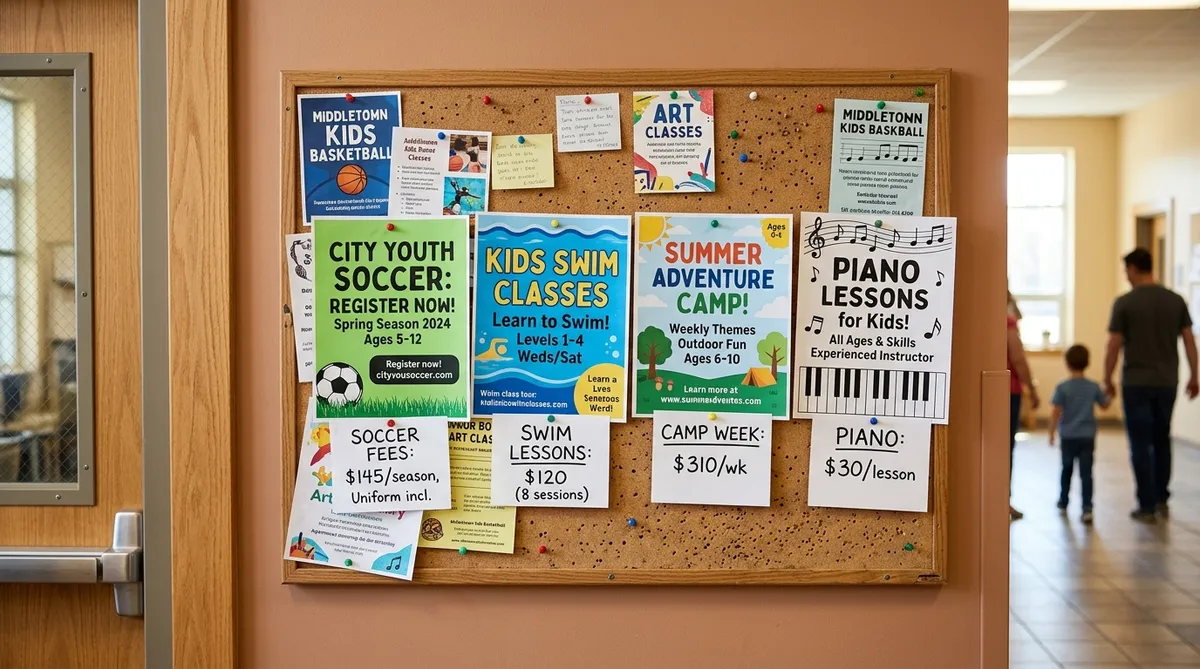
Kids' extracurricular activities typically cost divorced parents $100 to $500 per month per child, depending on the activity and where you live. Sports like hockey can run $6,000 annually in Canada, while summer day camps average $300 to $600 per week across the U.S. and Canada. As of March 2026, these are typical costs for kids' activities that divorced parents fight about.
| Activity | Monthly Cost | Annual Cost |
|---|---|---|
| Judo / martial arts | $100–$150 | $1,200–$1,800 |
| Swimming lessons | $60–$120 | $720–$1,440 |
| Hockey (Canada) | $200–$500 | $2,400–$6,000 |
| Piano lessons | $120–$200 | $1,440–$2,400 |
| Summer day camp | N/A (one-time) | $300–$600/week |
| Soccer league | $50–$100 | $600–$1,200 |
| Tutoring | $150–$300 | $1,800–$3,600 |
| Private Saturday school | $200–$300 | $2,400–$3,600 |
With three kids, these numbers stack fast. I was paying $130/month for judo plus $260/month for private Saturday school for two of my kids. That's $390 every month before we even get to swimming, school supplies, or the random $50 charges that pop up weekly.
We ended up dropping the private Saturday school and switching to a tutor. Not because it wasn't good — because I couldn't keep covering the full cost alone and the constant negotiation was exhausting.

Who Decides Which Activities the Kids Do?
This is the real question, and it's where most co-parents get stuck. The cost itself is often secondary to the control. My ex once told me, "I'm not going to pay for your impulse purchases." She was talking about swimming lessons for our five-year-old.
A few ground rules that work (based on two years of doing this wrong before doing it right):
Pre-enrollment agreement. Before signing your kid up for anything over $50/month, send your co-parent a message with three things: what the activity is, what it costs, and why your kid wants it. Give them 48 hours to respond. If you skip this step, you lose the moral high ground when they refuse to pay.
Distinguish needs from wants. Tutoring for a kid who's falling behind in math? That's a need. A third sport when they already do two? That's a want. Courts generally side with needs.
Let the kids' voice matter. When my son asked for judo for an entire year, that wasn't a passing interest. Document it. "He's been asking since March 2025" carries weight if you ever end up in front of a judge.
Don't weaponize activities. I've seen co-parents refuse to pay for an activity purely to punish the other parent. The kids always notice. Always.
What Happens When Your Co-Parent Refuses to Pay Their Share?
When a co-parent refuses to pay their share of extracurricular costs, the paying parent can absorb the expense, withdraw the child from the activity, or file a court motion for enforcement or modification of the custody agreement. None of these feel great.
I chose to pay for judo alone for three months. $390 total out of my pocket. Was it fair? No. But my son was already enrolled, he loved it, and pulling him out to make a point about money felt wrong. Sometimes you eat the cost because the alternative hurts your kid more than your wallet.
If the amounts are large and ongoing, the American Academy of Matrimonial Lawyers recommends documenting everything and requesting a court modification. Keep every receipt, every text message, every enrollment confirmation. Courts look at patterns, not one-off disagreements.
For a detailed look at what to do when your co-parent won't pay, read our guide on what to do when your co-parent won't split expenses.
How to Track Extracurricular Expenses Without Losing Your Mind
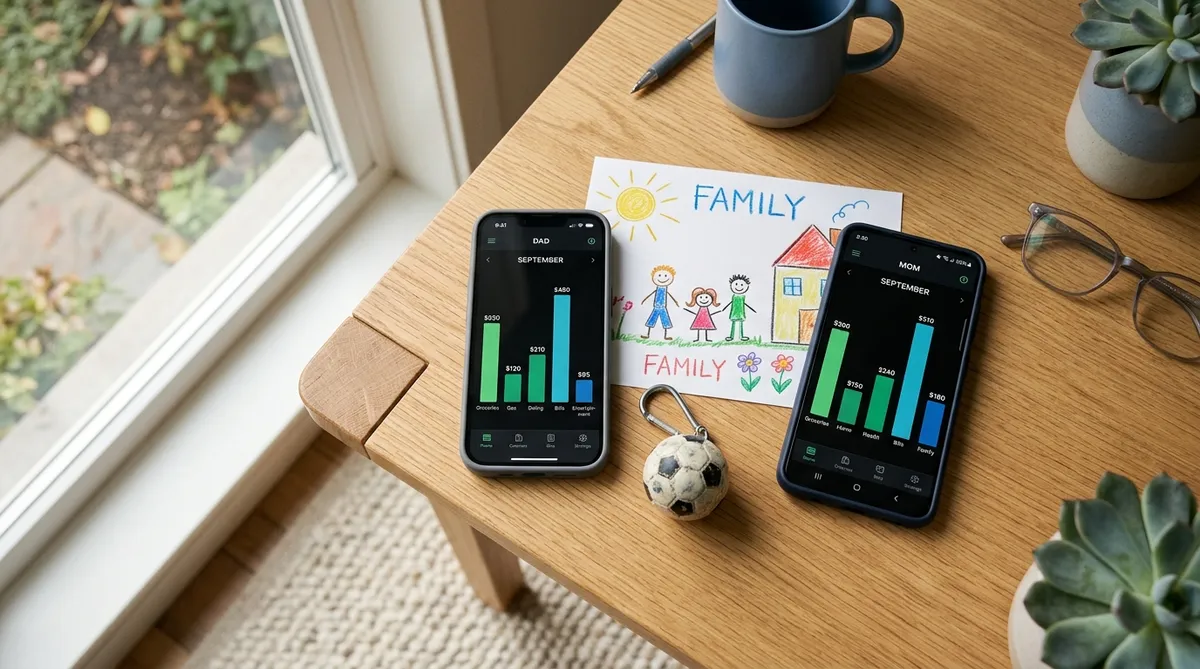
Track co-parenting extracurricular expenses by logging every cost on the day it happens in a single shared system, whether that's an app, a spreadsheet, or a shared document. Record the date, category, child's name, exact amount with receipt, and whether both parents agreed beforehand.
Before I built a system for this, I was sending WhatsApp photos of receipts to my ex. She'd ask "what's this for?" I'd explain. She'd say she never agreed to it. I'd scroll back through three weeks of messages trying to find where I told her about it. By the time I found the proof, we'd already argued about two other things.
The tracking method matters less than the consistency. Whether you use an app, a spreadsheet, or a shared Google Doc, log every expense the same day you make it. Every. Single. Time. I cannot stress this enough. The expenses you forget to log are the ones that cause the biggest fights two weeks later.
Here's what good tracking looks like for extracurricular costs:
- Date of expense (not the date you remembered to log it)
- Category — sports, arts, academic, camp, other
- Which child — matters a lot when you have more than one kid
- Amount and receipt — photo of the receipt, not "I think it was around $60"
- Pre-agreed or not — did both parents agree before enrollment?
Our expense tracking template guide walks through setting this up step by step.
Ready to simplify co-parent expenses?
CoParentSplit makes it easy to track, split, and settle shared child expenses — no conflict required.
Start Free NowHow to Have the Extracurricular Cost Conversation (Without It Becoming a Fight)
The most effective approach to discussing extracurricular costs with your co-parent is to communicate only in writing, during business hours, with a 24-hour response window. Review expenses monthly rather than per-transaction, and use pre-set category rules to cut down on recurring arguments.
My communication with my ex about money happens over WhatsApp. Going through a lawyer for every $130 judo payment would cost more than the judo itself. So we text.
What I've learned: never bring up money at kid pickup or dropoff. The kids hear everything. My rule now is that all financial conversations happen in writing, during work hours, with at least a 24-hour response window. No late-night texts about receipts. No "you owe me" messages at 7 AM.
A framework that has reduced our arguments by maybe 80%:
- Monthly review, not daily. Instead of arguing about each expense, we tally everything at month-end. One conversation instead of twelve.
- Categories with pre-set rules. Medical and school expenses: always split. Extracurriculars: split if both agreed beforehand. One-parent decisions: that parent pays.
- A shared system both parents can see. When both of you can log in and see the same numbers, there's nothing to argue about. The math is the math.
When I started tracking everything in one place instead of scattered WhatsApp threads, I realized I was paying way more than 50%. Not because my ex was cheating me — because I was buying things for the kids and just... not logging them. A $15 haircut here, a $30 school lunch top-up there. It added up to hundreds of dollars a month that I never asked to split.
What About Tax Deductions for Extracurricular Costs?
In Canada, the Children's Fitness Tax Credit was eliminated federally in 2017, but some provinces still offer credits for kids' activities. In the U.S., extracurricular expenses generally aren't tax-deductible unless they qualify as dependent care (summer day camps while you work, for example).
The parent who pays the expense typically claims the deduction. If you split 50/50, you each claim your half. Keep receipts — the CRA and IRS both want documentation.
For the full breakdown, check out our guide on co-parenting expense tax deductions in 2026.
A Practical Plan for Splitting Extracurricular Costs
A practical plan for splitting extracurricular costs starts with auditing current activities, agreeing on a split method (50/50 or proportional to income), setting a dollar threshold that requires mutual approval, tracking everything in one shared system, and reviewing together monthly.
Here's what I'd tell any divorced parent dealing with this for the first time. This is what I do with three kids in Montreal.
Step 1: Audit current activities. Write down every activity each child does, what it costs monthly and annually, and who's been paying. You might be surprised.
Step 2: Agree on a split method. 50/50, proportional, or hybrid. Put it in writing. Even a text message that says "we'll split soccer and swimming 50/50 and each handle our own extras" counts.
Step 3: Set an approval threshold. We use $75. Anything under $75 per month, either parent can enroll without asking. Over $75 requires a conversation first.
Step 4: Track everything in one place. Not WhatsApp. Not your memory. One shared system where both parents can see every expense. You can use our free expense calculator to see what a fair split looks like for your situation.
Step 5: Review monthly. Pick a day — first Sunday of the month, whatever works. Look at the numbers together (or separately, if being in the same room is too much). Settle up. Move on.
The point isn't to build a perfect system. It's to take the emotion out of the money. Every dollar you track is one fewer argument waiting to happen.
Ready to simplify co-parent expenses?
CoParentSplit makes it easy to track, split, and settle shared child expenses — no conflict required.
Start Free Now
Founder of CoParentSplit
Single dad of 3, product manager, and immigrant in Montreal. Built CoParentSplit after his own divorce because he needed a simpler way to split child expenses with his co-parent.